A museum designed to look at the Parthenon
Tschumi's Acropolis Museum hovers over an ancient city, turns to face the Parthenon and leaves absence visible. Notes from Athens.
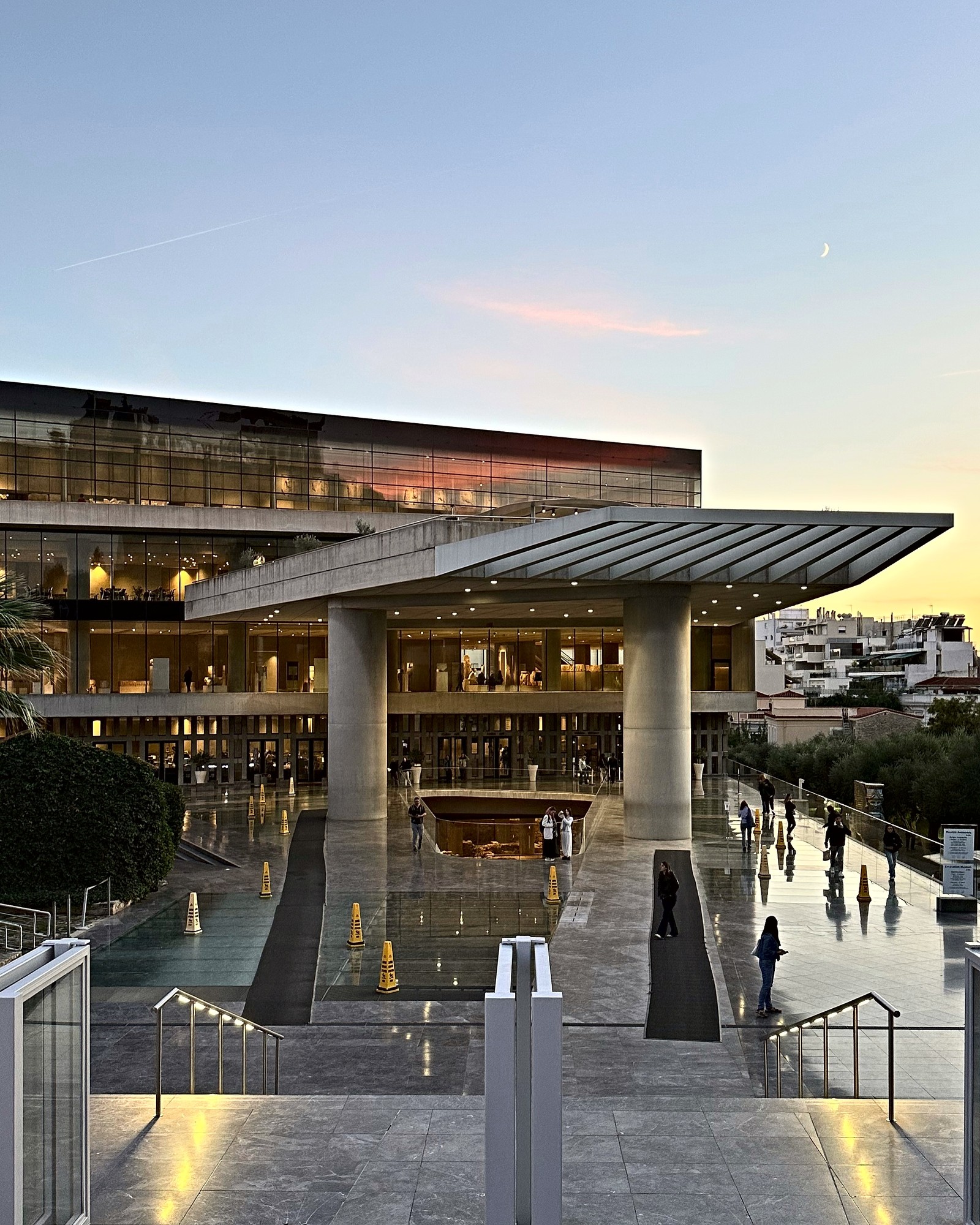
The Acropolis Museum, by Bernard Tschumi with Greek architect Michael Photiadis, opened in June 2009 after more than 30 years of attempts. The competitions of 1976 and 1979 led nowhere. The 1989 one had a winner, but construction stopped at the foundations: the site revealed an entire ancient neighbourhood, with streets, courtyard houses, wells, baths and workshops, inhabited from the 4th millennium BC to the 12th century AD. Tschumi won the next competition, in 2001.
His design starts from that respect for what was already there. The building rests on columns and hovers over the excavation. Glass floors let you walk in above the ruins, and the city below stays visible, never buried.
The surroundings
Next door, the Weiler Building, a military hospital completed in 1836, still stands and now houses the museum's offices. Old and new share the same square, about 300 metres from the Parthenon.
Three layers
The base, over the ruins, where the Gallery of the Slopes rises on a glass-floored ramp, like climbing the hill itself.
The middle, a double-height space where the Archaic sculptures are seen in natural light, as they once were outdoors.
The top, the glass-enclosed Parthenon Gallery, turned to share the temple's orientation. The frieze wraps a core with the same dimensions as the Parthenon's cella, each block in its original position, among steel columns equal in number to the temple's. Glass façades keep the Acropolis always in view.
The respect for absence
What moved me most was the respect for absence. Nothing is rebuilt. The pieces come as time left them: broken, headless, incomplete. Fragments sit in steel frames that hold the empty space around them. The parts of the frieze held in London appear as plaster casts, so what is missing stays visible. Of the six Caryatids, five stand here; the sixth, in the British Museum.
Concrete, glass and marble. A contemporary building that doesn't compete with the monument. It points to it.
Acropolis Museum, Athens. All photos by Fernanda Algazal.