10Confette
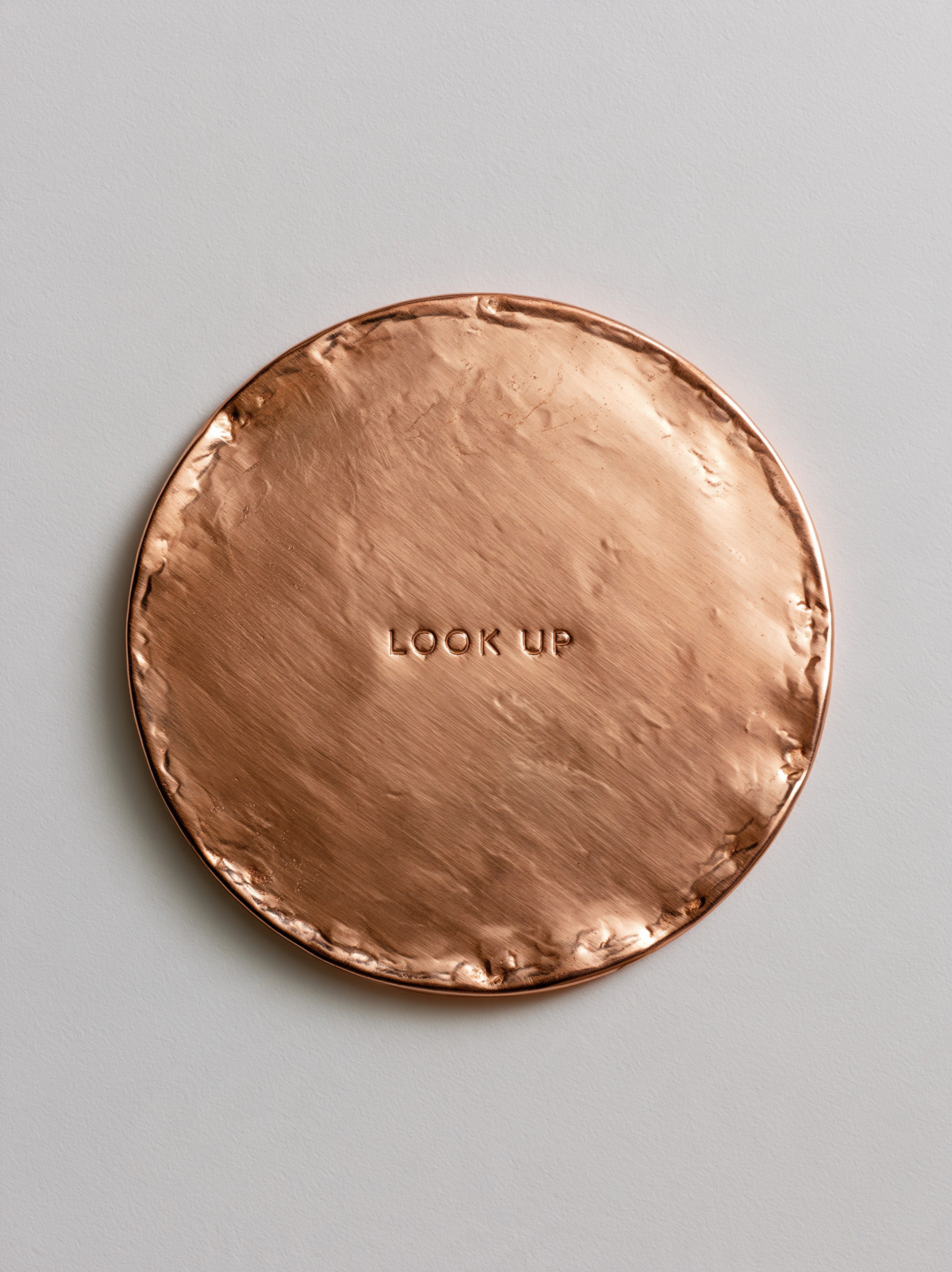
Ten hammered copper discs, each with a few kind words for a stranger, placed discreetly around the city. What Carnival leaves behind, made to last — and a quiet claim on who gets to speak in public.
Client
Location
Category
Year

01. What Carnival leaves behind
I grew up with Carnival. For a few days every year, Brazilian cities suspend their own rules. Bodies take over avenues that were built for cars. Strangers dance with strangers. The functional noise of traffic and commerce gets replaced by music. Fabric, glitter and paper cover the buildings, and the street stops being infrastructure and becomes, for a moment, a place where people are simply allowed to be together — for no reason anyone could write on a spreadsheet.
Then it ends. And what's left on the ground is confetti.
I've always thought confetti is the most honest thing Carnival produces. It's tiny. It belongs to no one. Nobody sells it, nobody counts it, nobody picks it up. It lands on shoulders and pavements, drifts into shops and churches and banks, ignores every line between public and private. It's the physical proof that, for a moment, the city was occupied by something that wasn't productive, wasn't useful and wasn't for sale. Just celebration. Weeks later there are still a few pieces in the gutter, insisting that it happened.
Confete starts from that leftover. I wanted to know what it would mean to make it permanent.
02. Ten small exceptions
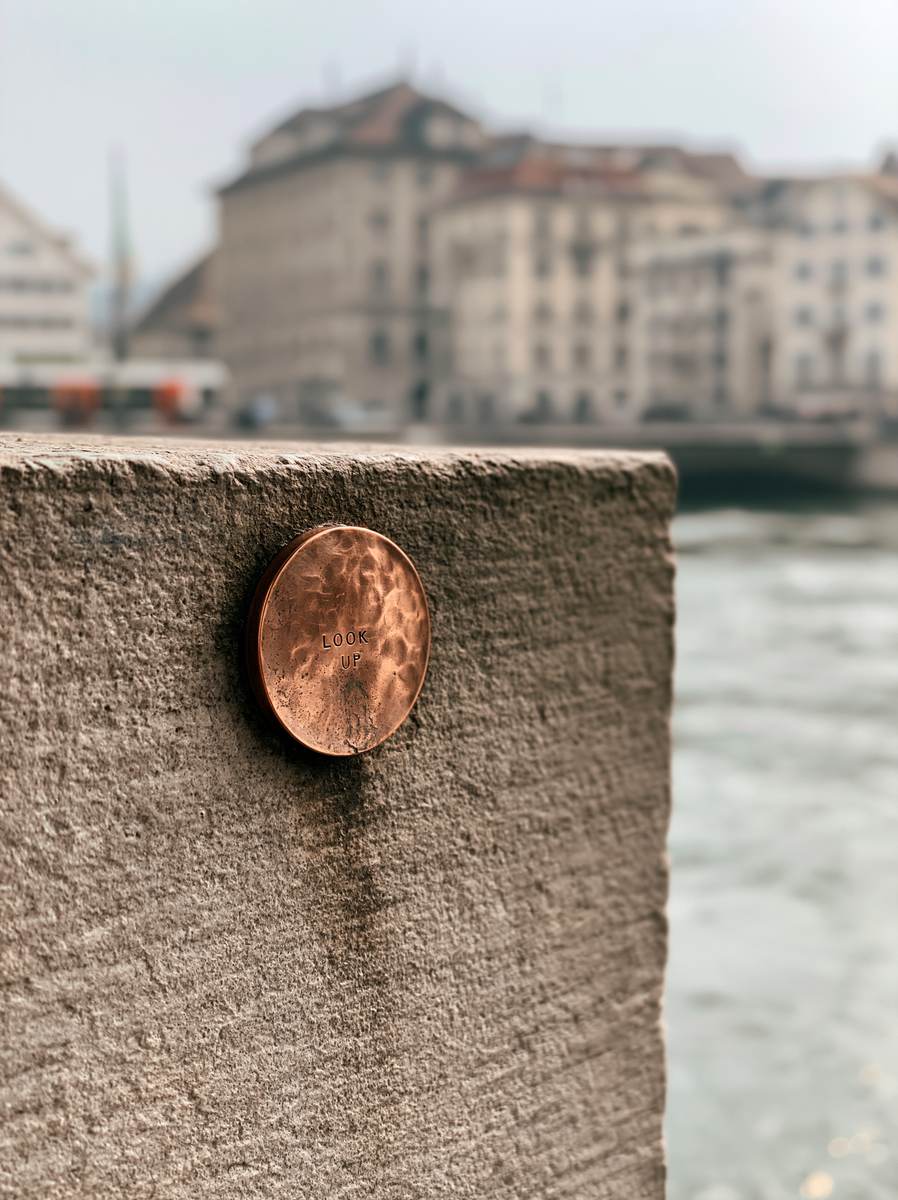
So I made ten small discs of hammered copper, each one a different size, and I've been placing them discreetly around the city. Small enough to be missed. Placed exactly where people usually miss things — the corner of a stone wall by the river, eye level on a facade, the edge of a bridge you cross every day without ever looking at it.
Each disc carries a short sentence. LOOK UP. STAY A LITTLE LONGER. TAKE THE LONG WAY HOME. YOU LOOK GOOD HERE. They're not instructions and they're not slogans. They're the kind of thing a friend says to you in passing — a hand on the shoulder, a small permission. For a couple of seconds they interrupt a body on its way somewhere, and they offer nothing back except the pause itself.
Where Carnival uses paper that blows away, I chose copper, because copper stays and ages in public. It oxidises. It darkens with rain, keeps the soot of the traffic, records every hand that touches it. Each disc leaves my workshop bright and new, and from that day on the city finishes the work — slowly, over years, in its own weather. The piece is never done. It keeps being written on by the place it lives in. I like that I'm not the only author.
03. Who is allowed to speak here
There's a quiet dispute going on in every city, and it's about who has the right to talk to us in public.
Look at what a city actually says. Almost every message on its surfaces has a job. Facades became brands. Screens became advertising. Signs tell us where to go, where to stop, what's forbidden, who's watching. Even the friendliest words on the street — welcome, enjoy, discover — are usually the first line of a transaction. Our attention became the most valuable real estate in the city, and it's sold by the square centimetre to whoever can pay.
10Confette takes a few of those centimetres and asks for nothing back. There's no product. No QR code. No call to action, no hashtag, no brand quietly explaining the experience and collecting your data on the way out.
That's the political gesture, and I wanted it to be deliberately not an angry one. The politics of 10Confette is not in writing a political statement on a plaque — that would just be one more message competing for attention in the same market. It's in putting, inside the regulated language of the city, a kind of communication that escapes the commercial and functional logic that decides what deserves our surfaces and our eyes. It's in proving, ten times over, that a message can exist in public without wanting something from you. I kept the sentences soft on purpose. The politics is in the occupation, not in the slogan.
Underneath it all there's a very simple claim, and an old one: the city belongs to the people who walk through it, and it can also be a place for imagination, tenderness and play — not only for circulation and consumption. Carnival knows this and says it loudly, once a year. Confete says it quietly, all year round, in copper.
Ten tiny exceptions in the way a city speaks. Ten places where someone was allowed to leave a kind word for a stranger and ask for nothing in return.
How much freedom can fit inside a circle?
04. Where, when, with whom
Zürich, Switzerland. 2026. A autoral project by ALGAZAL//CO.