OFFCUT
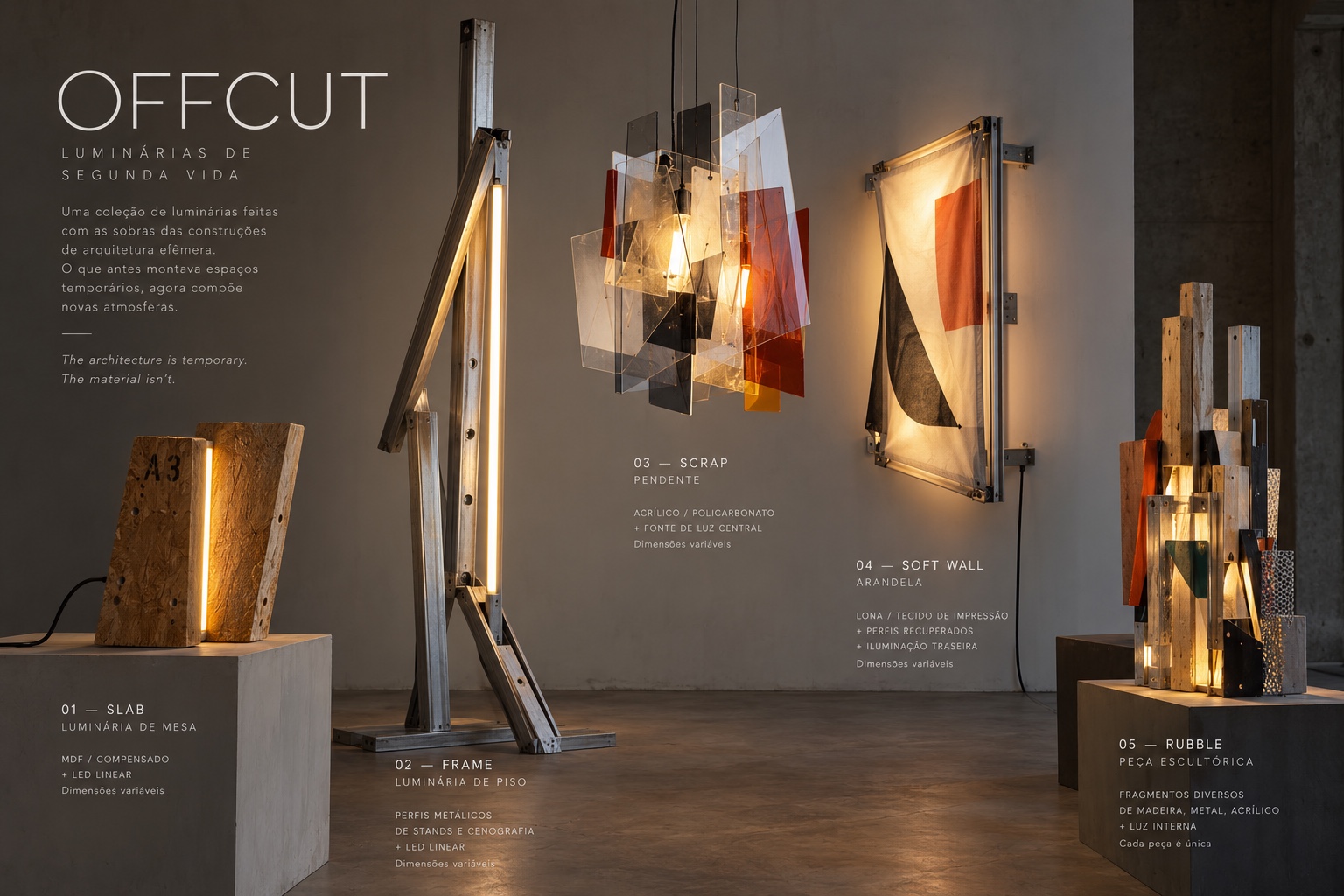
Five kit-built lamps from the offcuts of ephemeral architecture, gifted to each job's crew. Manual on request. The architecture is temporary; the material isn't.
Client
Location
Category
Year

The leftover architecture
Every stand, pop-up and stage set ends the same way: it comes down in a night. What stays behind is a second architecture nobody drew — sheets of MDF with assembly numbers still written on them, aluminium profiles drilled for someone else's wall, scratched acrylic, printed canvas from a campaign that is already over.
Our scenography assembly partner, a workshop in Embu das Artes, São Paulo, that builds a large share of our ephemeral work, lives with that pile every week. They invited us to look at it as a material library rather than a disposal problem, and to turn it into something they could sell, and give as a gift to the people they build with.
How much is left
We started by measuring the problem. A mid-sized scenography workshop delivers somewhere around a hundred builds a year: trade-fair stands, brand activations, event sets. At an average of 60 m² per build, that is about 6,000 m² of temporary construction a year. Most of it is panel material used once. By our estimate that comes to roughly 2,000–3,000 sheets of MDF and plywood a year, on the order of 150 tonnes, plus metal profiles, acrylic, polycarbonate and large-format prints. On top of that, CNC nesting alone leaves 10–15% of every sheet as offcut before anything is even built.
These are order-of-magnitude figures, not an audit. They were enough to show that the collection would never be short of material. The hard part was having a design language strict enough to absorb material we cannot predict.
The rule
Don't cut the material to hide where it came from. Cut only when the structure needs it.
The dimensions, holes, cuts and marks of each offcut become part of the drawing. Screws stay visible, edges stay raw, assembly numbers stay written on the panels. Nothing reads as "eco": no rope, no pretty wood, no crafted-recycled look. The references are closer to clean brutalism, industrial prototypes and gallery objects.
Instead of choosing an aesthetic and then looking for waste that matches it, we did the opposite. Each of the five pieces is built around one family of waste. Together they read almost like five scales of the architecture they came from.
The collection
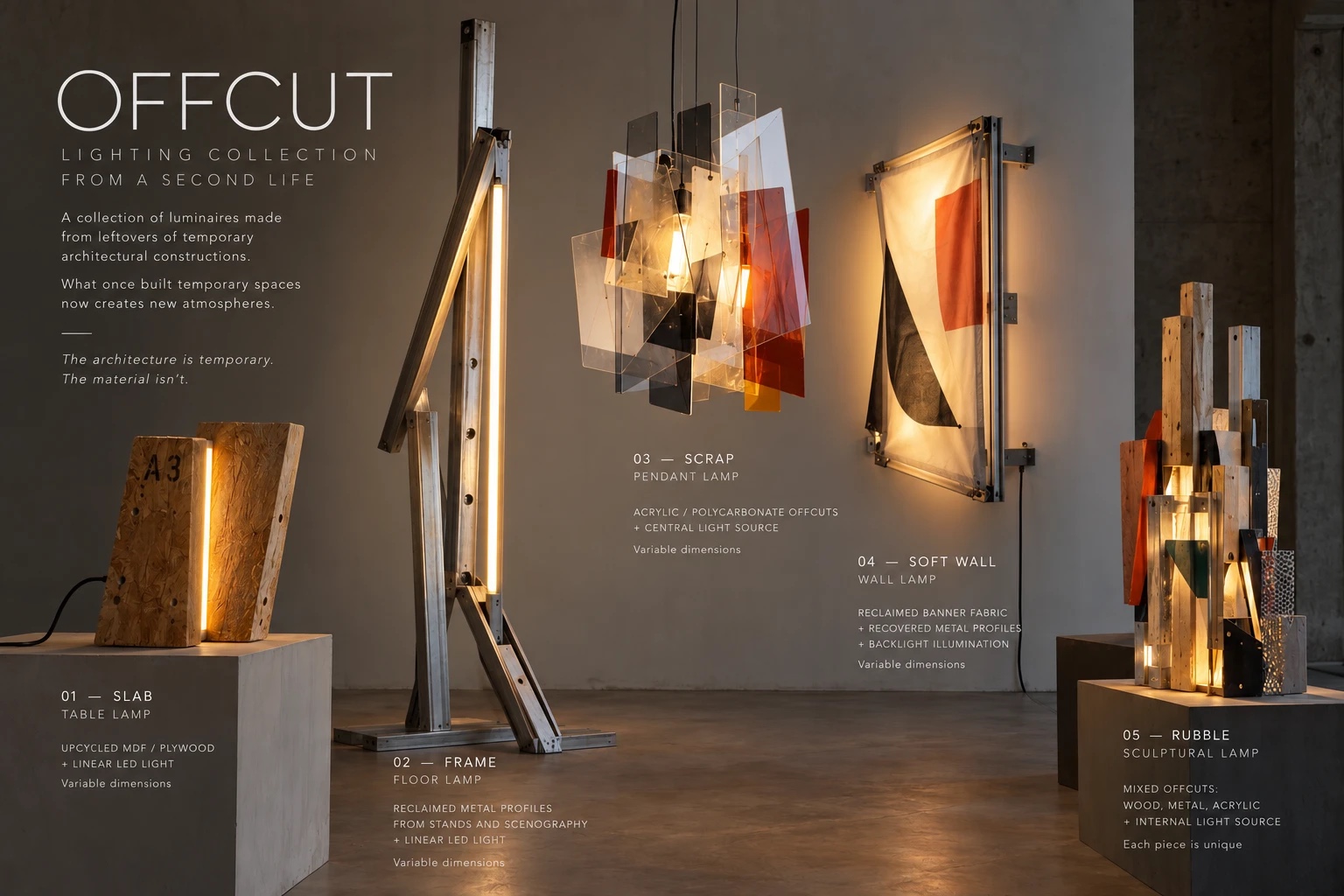
01 — SLAB · table lamp
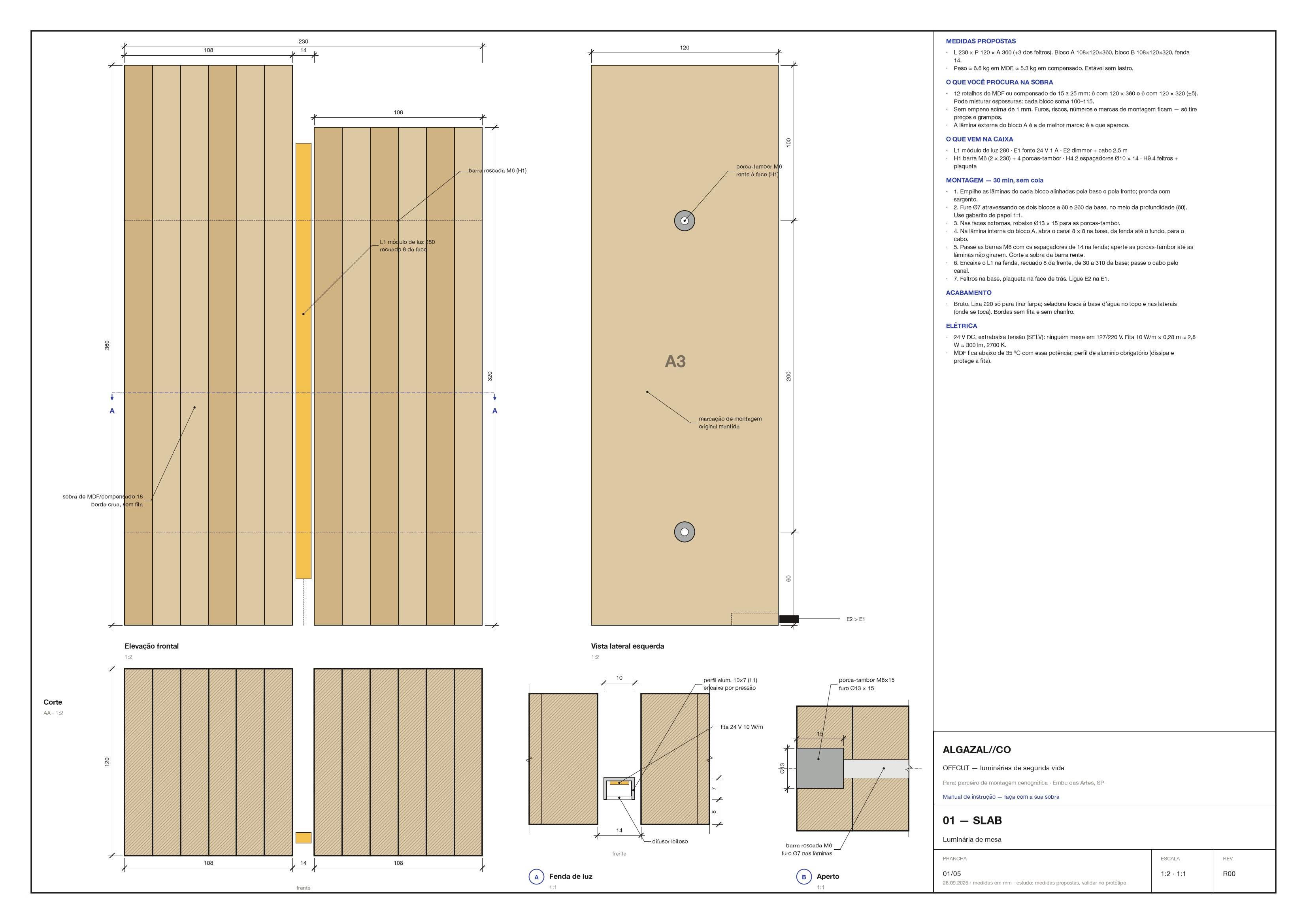
Two blocks built from stacked MDF or plywood offcuts, held together by two threaded rods, with the assembly numbers still written on the outer face. A 14 mm slot between the blocks holds the light. A small architectural fragment, lit from inside. 230 × 120 × 360 mm.
Material: MDF / plywood offcuts + linear LED.
02 — FRAME · floor lamp
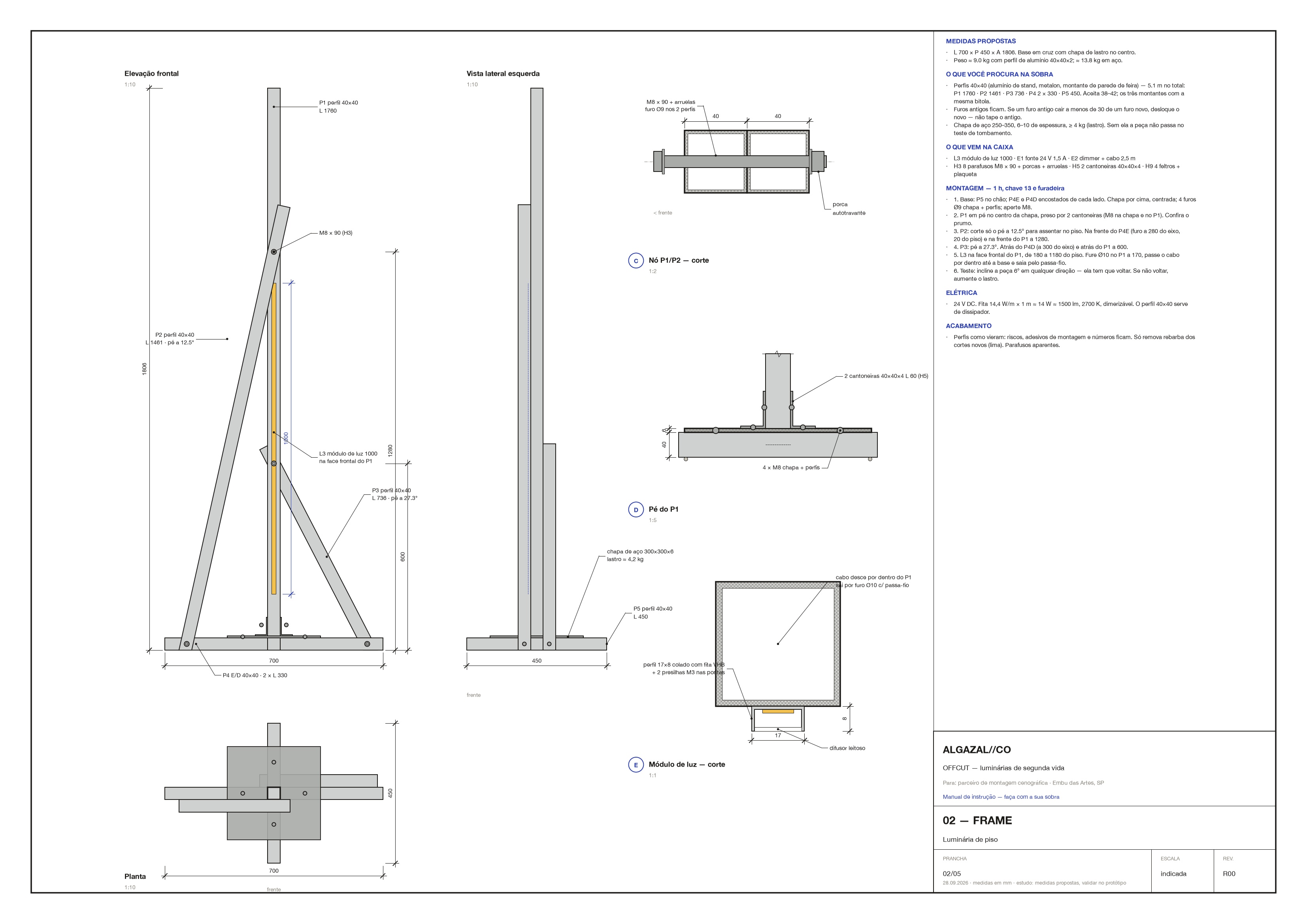
Three or four lengths of the aluminium and steel profiles that hold up temporary walls and stands, assembled into a tall, slightly off-balance structure, almost a three-dimensional sketch. The light runs along a single profile.
Material: stand and scenography profiles + linear LED.
03 — SCRAP · pendant
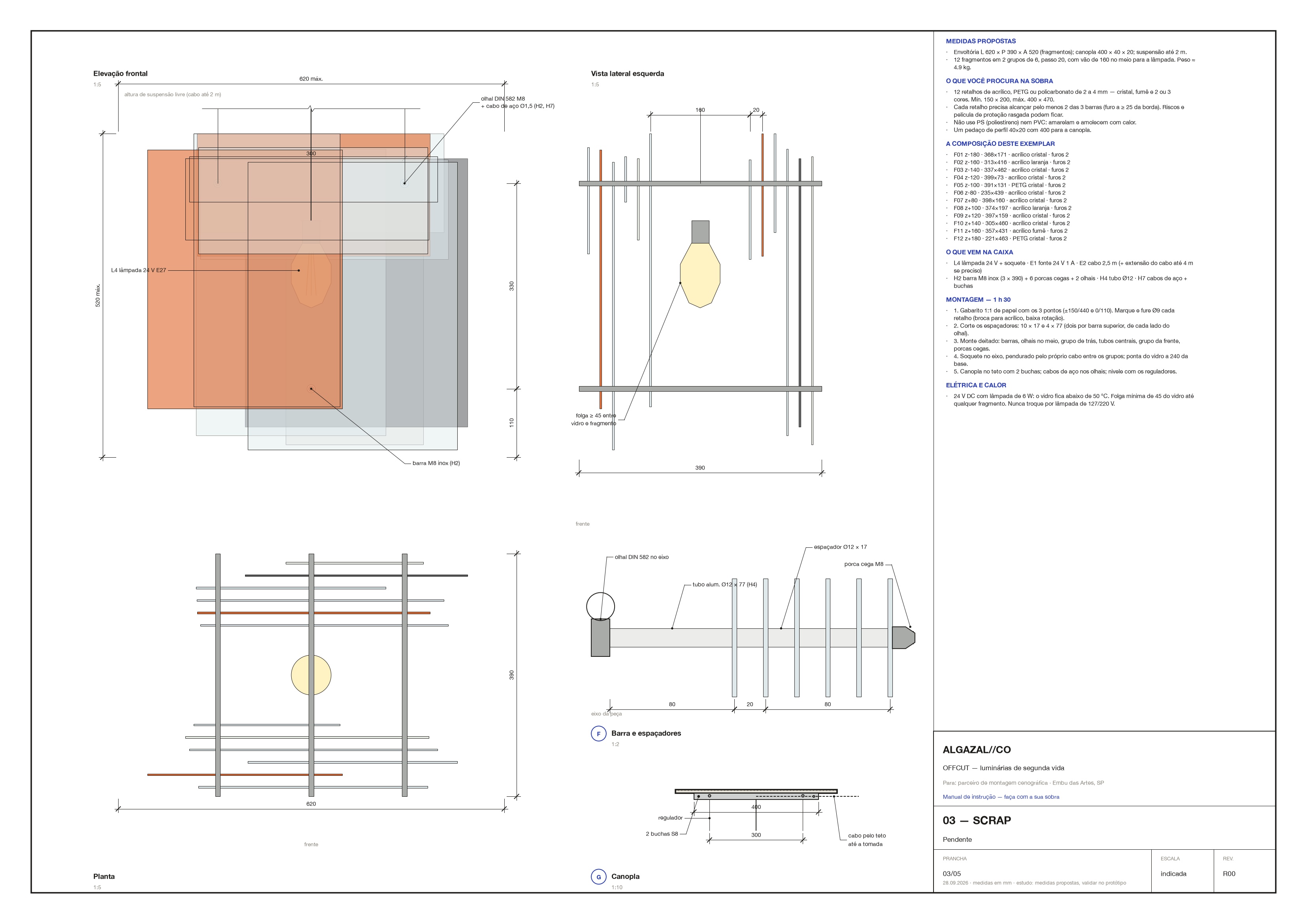
Fragments of translucent acrylic, polycarbonate, PETG and coloured sheet hung around a single light source. It isn't round or symmetrical: it hangs like a cluster of material samples.
Material: acrylic / polycarbonate + central light source.
04 — SOFT WALL · wall lamp
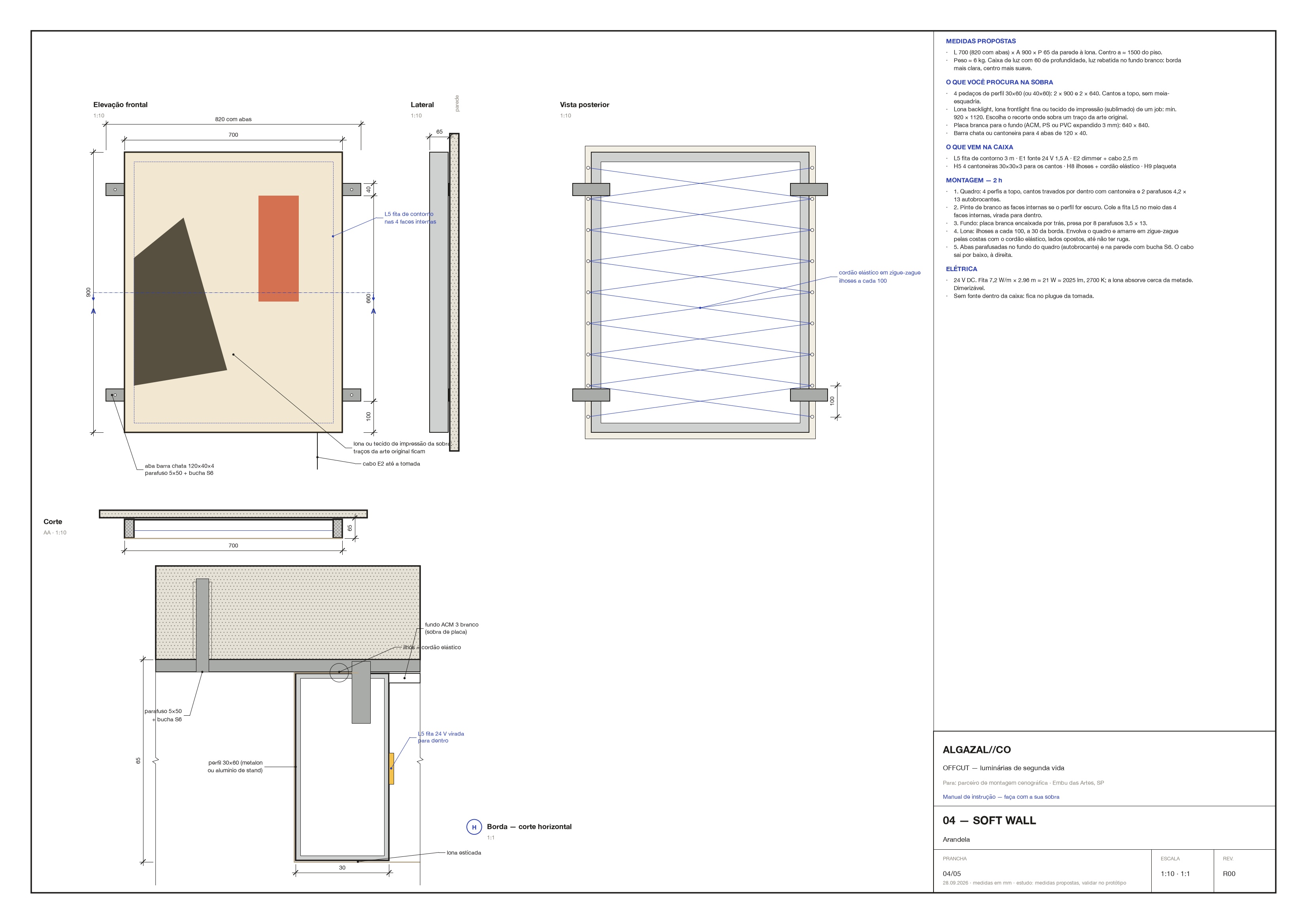
Leftover canvas, tensioned fabric and banner print stretched over a small frame of recovered profiles and lit from behind. What used to be a graphic surface becomes a diffuser, and traces of the original print stay visible.
Material: canvas / print fabric + recovered profiles + backlight.
05 — RUBBLE · sculptural piece
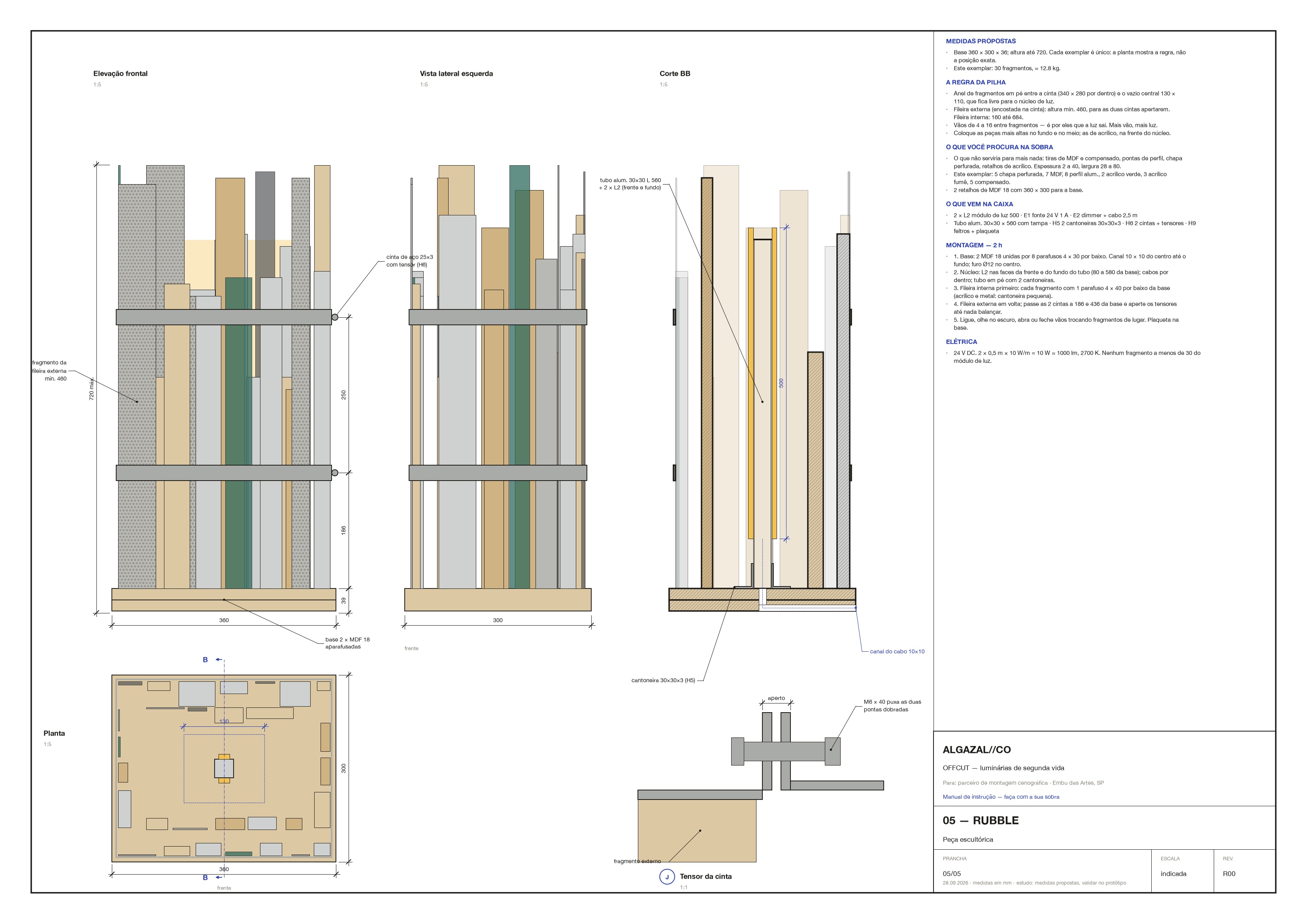
The most experimental one. The scraps nobody can reuse, wood, acrylic, metal and mesh, are stacked and pressed inside a simple frame. Light comes through the gaps between them. No two pieces can be the same.
Material: mixed fragments of wood, metal and acrylic + internal light.
A kit, almost a Lego
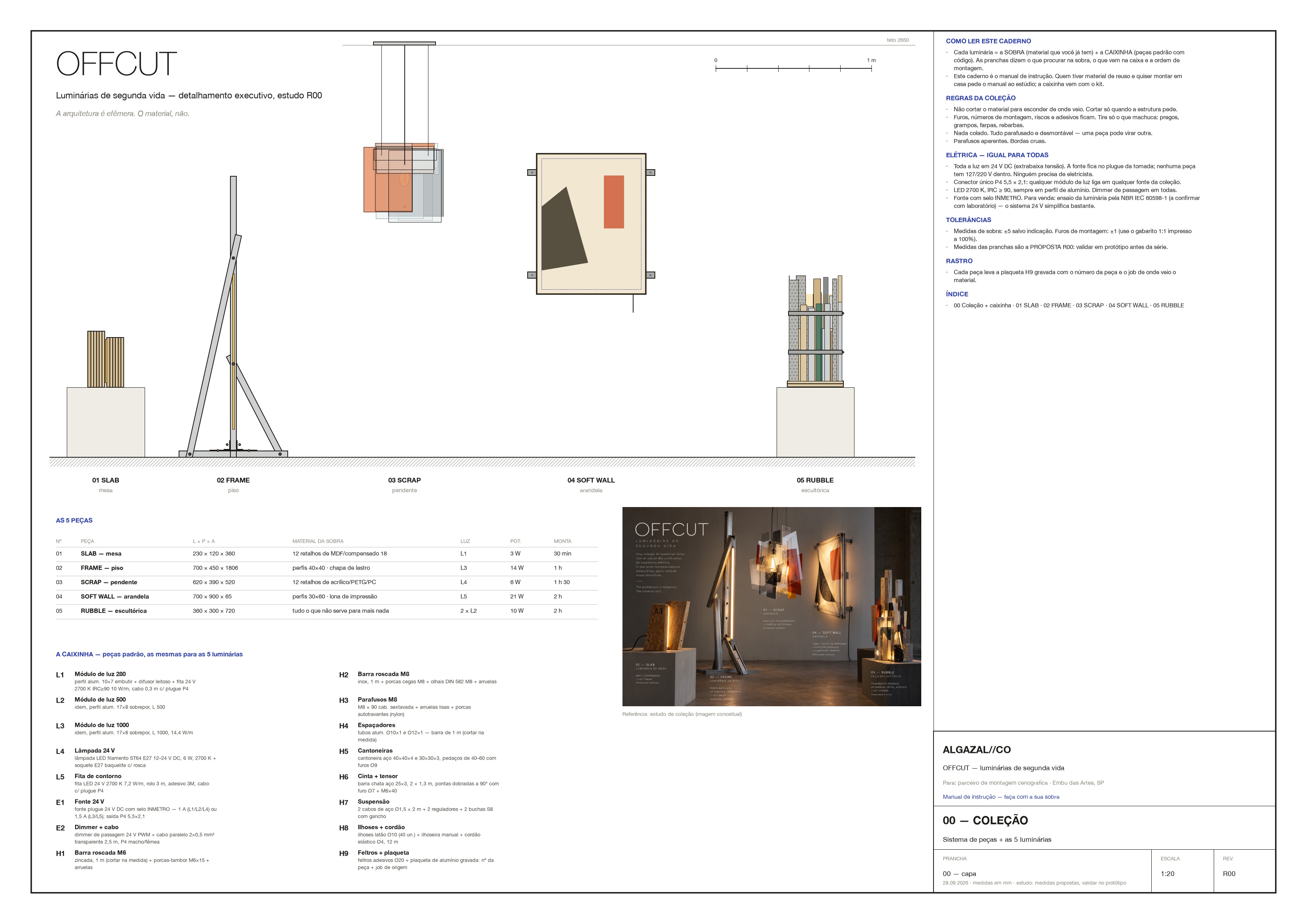
Each lamp is two things: the offcut, which is whatever material is left over, and a small box of standard parts. The box holds the light modules, the 24 V plug-in power supply, threaded rods, bolts, spacers and a small aluminium tag. The parts are coded and shared across all five pieces, so a light module from one lamp plugs into the power supply of any other.
Nothing is glued. Everything is bolted, so it can be taken apart and rebuilt as another piece. All the light runs at 24 V from a plug, so nobody needs an electrician or has to touch mains wiring. Assembly takes between 30 minutes and two hours with a drill and a spanner.
That turned the collection into a gift. At the end of a job, our partner sent the box and the material from that job to the agency, and to the producers, photographers and crew who worked on it, and they built the lamp themselves. The aluminium tag records which project the material came from. Kits went out across Brazil.
The idea keeps growing like a Lego set: you collect the parts you have, pick up a few more boxes, and build with your kids.
The instruction manual
The collection was built to be repeated. Each lamp has a full executive package: elevations, sections, 1:1 details, rules for which offcuts qualify, the parts list and the assembly steps. Anyone with reuse material who wants to build the lamps at home, with what they have, can get in touch and we send the instruction manual. We offer it as a courtesy to the people who make temporary architecture possible.
Where, when, with whom
OFFCUT — Second-life lamps
Collection of five lamps · Product design
2026 · Embu das Artes, São Paulo, Brazil
For: our scenography assembly partner
Design: ALGAZAL//CO
Kits delivered across Brazil · instruction manual on request