MISCI — Azulejo Brasileiro
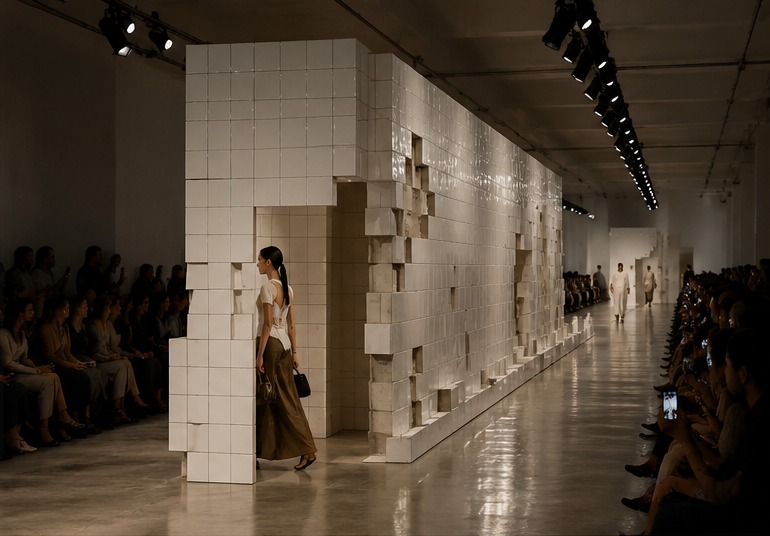
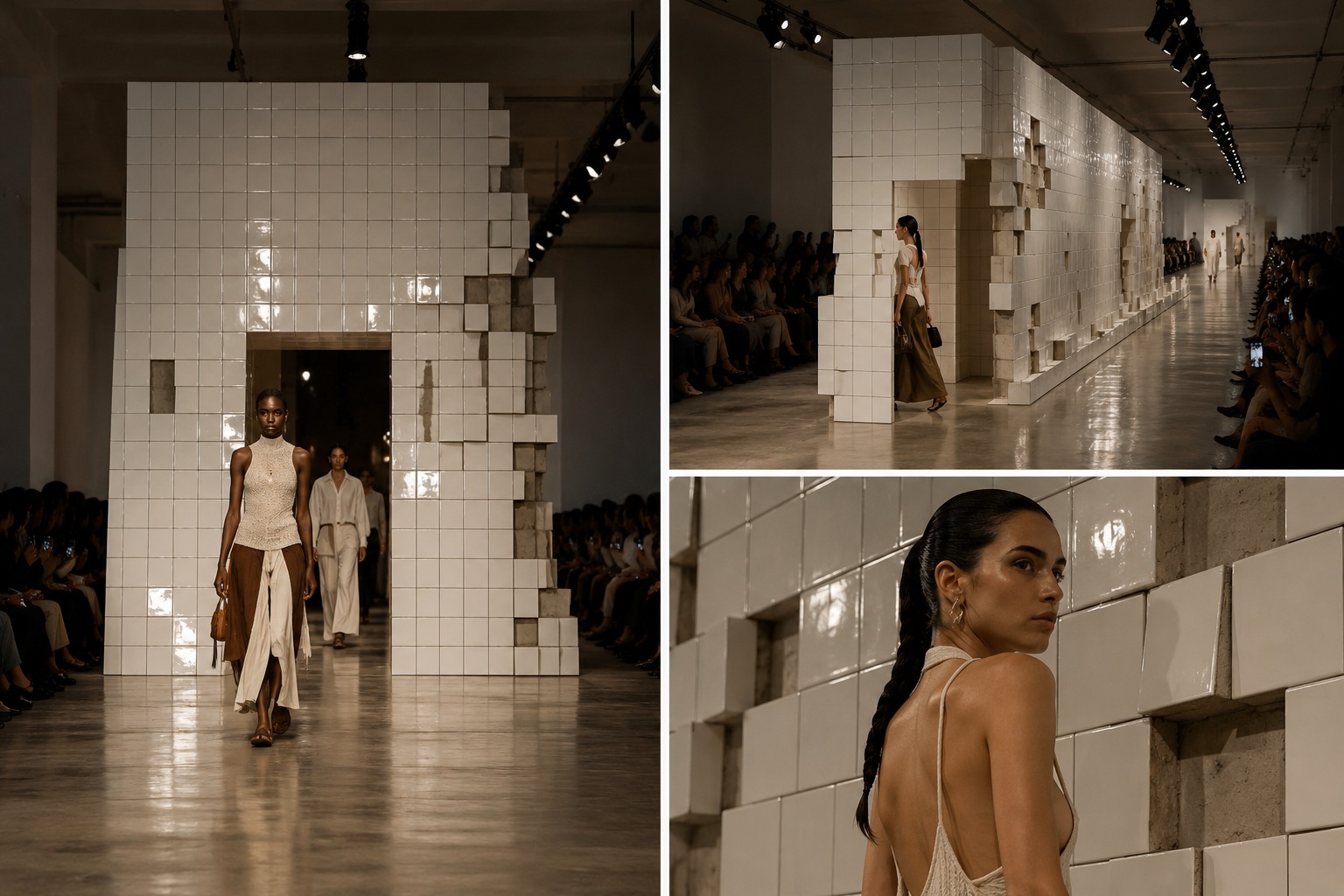
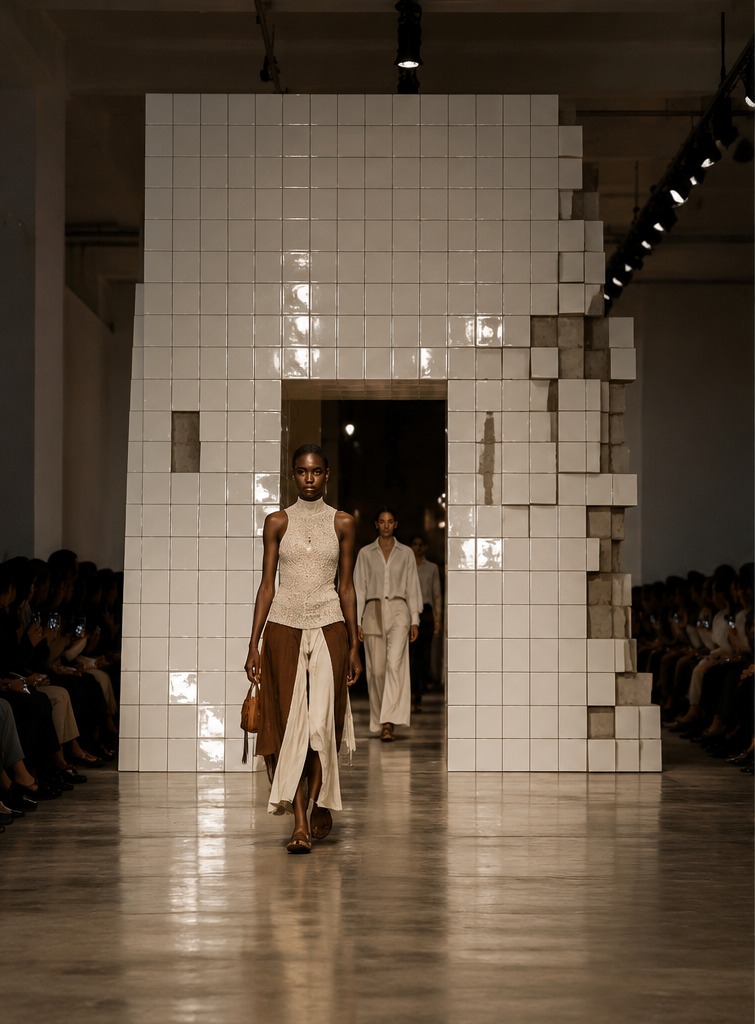
A runway study for MISCI: the cheap, glossy commercial tile of Brazilian bakeries, butchers and bars, built into a single wall whose grid slowly comes apart.
Client
Location
Category
Year

01. The Project
A runway scenography study for MISCI. The starting point is a material almost nobody looks at: the commercial tile that covers the walls of bakeries, butchers, bars, market stalls and bus-station bathrooms all over Brazil.
The runway is small, and the audience sits very close. So the question was never how to build architecture. It was which cheap, ordinary object, repeated often enough, could become architecture on its own.
02. The Tile
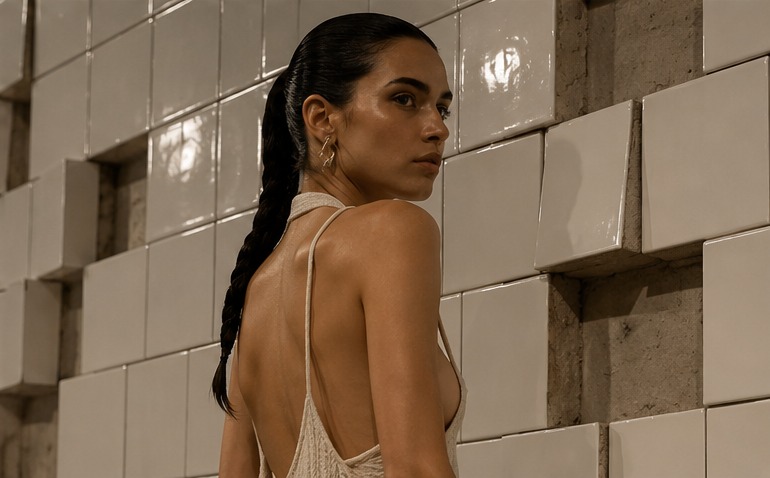
Not the Portuguese azulejo. No blue and white, no ornament, nothing that points to another tradition. This is the industrial tile: 15 × 15 or 20 × 20 cm, glossy, white, beige, hospital green or washed-out blue. It is cheap, it is washable and it is everywhere. It is so familiar that it is rarely seen as a designed object at all.
The distance between that material and a MISCI collection is where the project lives.
03. Why MISCI
MISCI treats Brazilian material culture as design language. Its sophistication does not come from importing foreign codes but from looking closely at what is already here and reworking it. Earlier shows have drawn on a countryside snack bar, Brazilian motor racing, Cinema Novo and modernist architecture.
So the set avoids every obvious sign of Brazil: no foliage, no tropical palette, no carnival, no fashion curtain. Here, Brazilianness is not decoration or a symbol. It is in the material.
04. The Wall
A single monolith clad in tile crosses the room, about 2.70 m high and 4 m wide. It does not read as a backdrop. It looks like a piece of Brazilian street architecture cut out and placed inside the hall. The models step out through a narrow opening in it.
The grid starts perfect and then goes wrong. Along the wall, tiles begin to rotate, leave the grid, push forward a few centimetres or disappear, until the geometry has almost dissolved and the raw block shows underneath. An ordinary surface turns into something close to sculpture, which is closer to the idea of miscigenação than any national symbol could be.
Built cheaply: modular MDF with a glossy finish for most of the surface, and real ceramic only where the camera gets close. The light is almost clinical, hard and white, bouncing off the glaze. The colour comes from the clothes.
A banal element becomes monumental. The everyday becomes the set. And the thing that normally stays in the background moves, for a few minutes, to the centre of the runway.
05. Where, when, with whom
Runway scenography study for MISCI by ALGAZAL//CO, 2026. Concept study.