Who Is Changing the Roadworks Signs in Zürich?
Someone in Zürich redraws the worker on the roadworks signs. In five weeks I catalogued 23 of them — a badger, a ladybug, a rooster, a dolphin, a witch — and built a film where the sign never moves. I'm looking for the artist.
Client
Location
Category
Year

01. This is not my work
Let me start with the only thing that really matters here: the signs are not mine. I didn't make them, I didn't commission them, nobody hired us. Somebody in Zürich goes out and redraws the little man on the roadworks signs, and I have been photographing that person's work without ever having met them.
Between 14 August and 22 September 2026 I catalogued 23 different signs, in 45 photographs, walking around the city. The sign is always the standard Swiss one: red equilateral triangle, white face, a black worker bent over his shovel and his heap of earth. What changes is who is holding the shovel.
What makes them so good is the discipline. Always black on white, always inside the border, always in the exact language of the original pictogram. You don't see a sticker slapped on a sign. You see that the man is different today.
02. The catalogue so far
Eighteen of the twenty-three carry a character I can name:
- The badger — striped face, still digging. Found three times.
- The wolf — a husky's head on the worker's shoulders. Three times.
- The witch — pointed hat, a wand throwing a star, a crescent moon and three stars overhead, and a small dog at her feet. Three times.
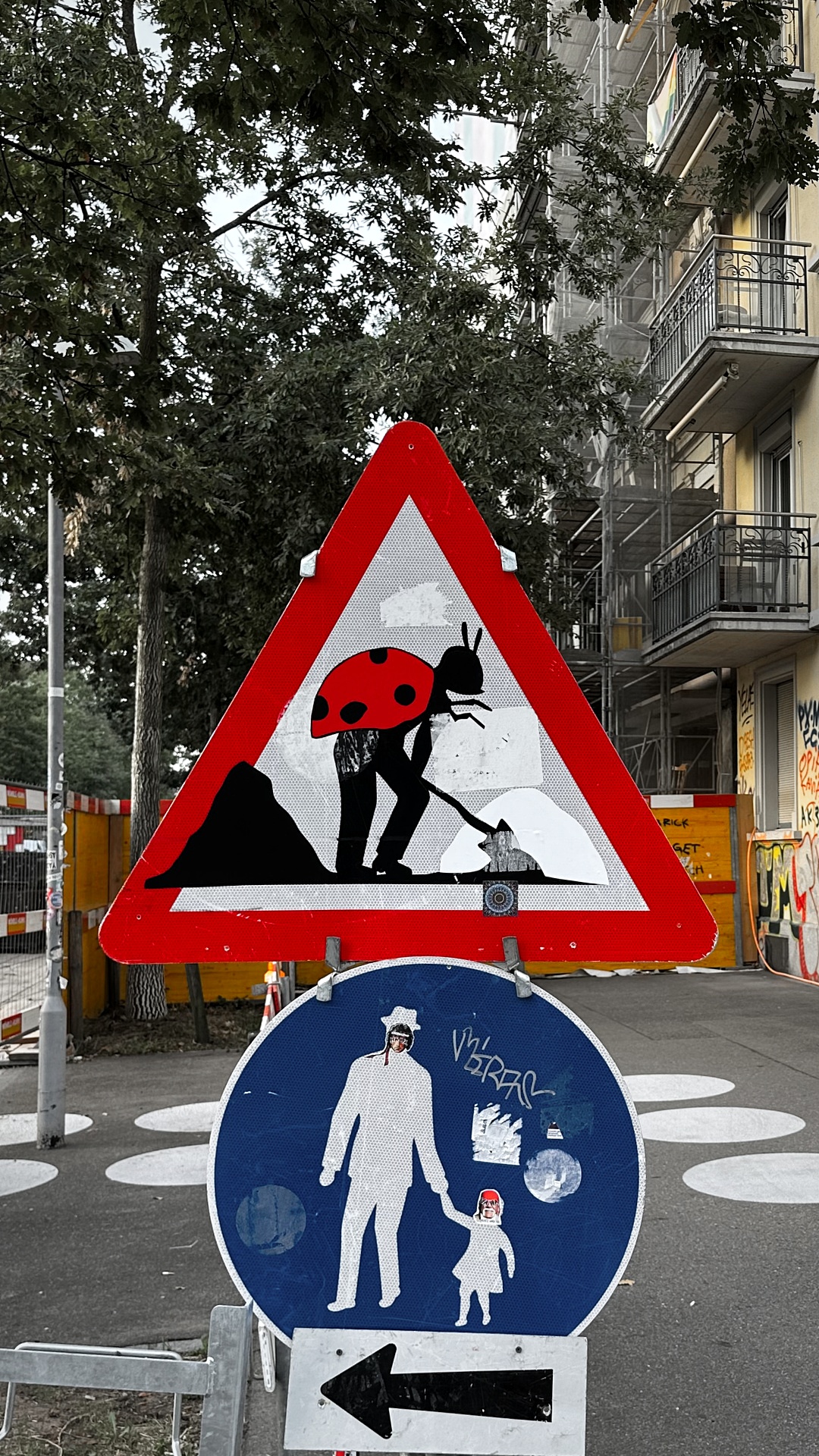
- The ladybug — a red shell with black spots, antennae, digging like everyone else.
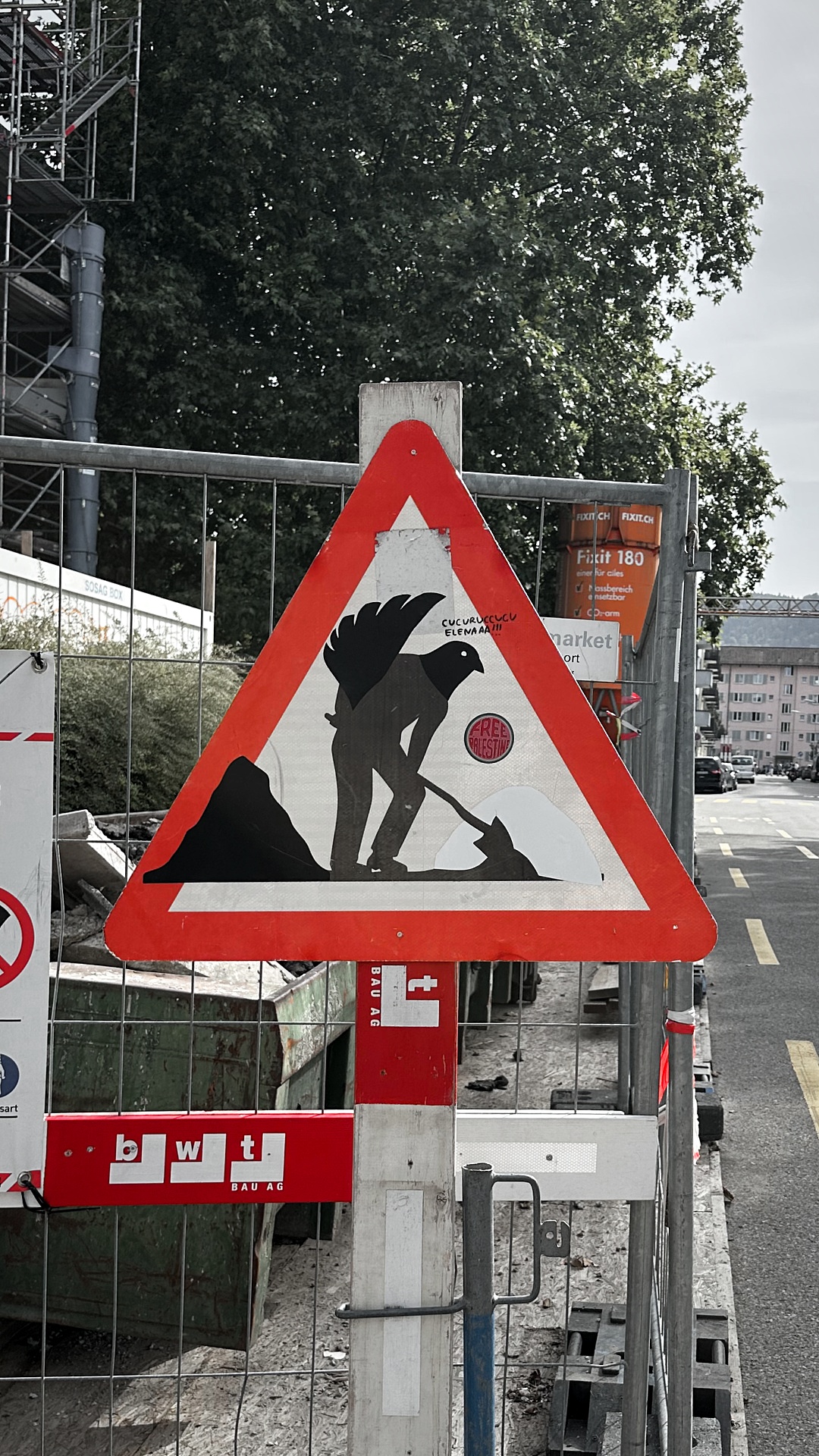
- The rooster — tail feathers up, and beside him, handwritten on the sign: CUCURUCUCU ELEMAAA!!!
- The dolphin — the whole upper body replaced, shovel still in hand.
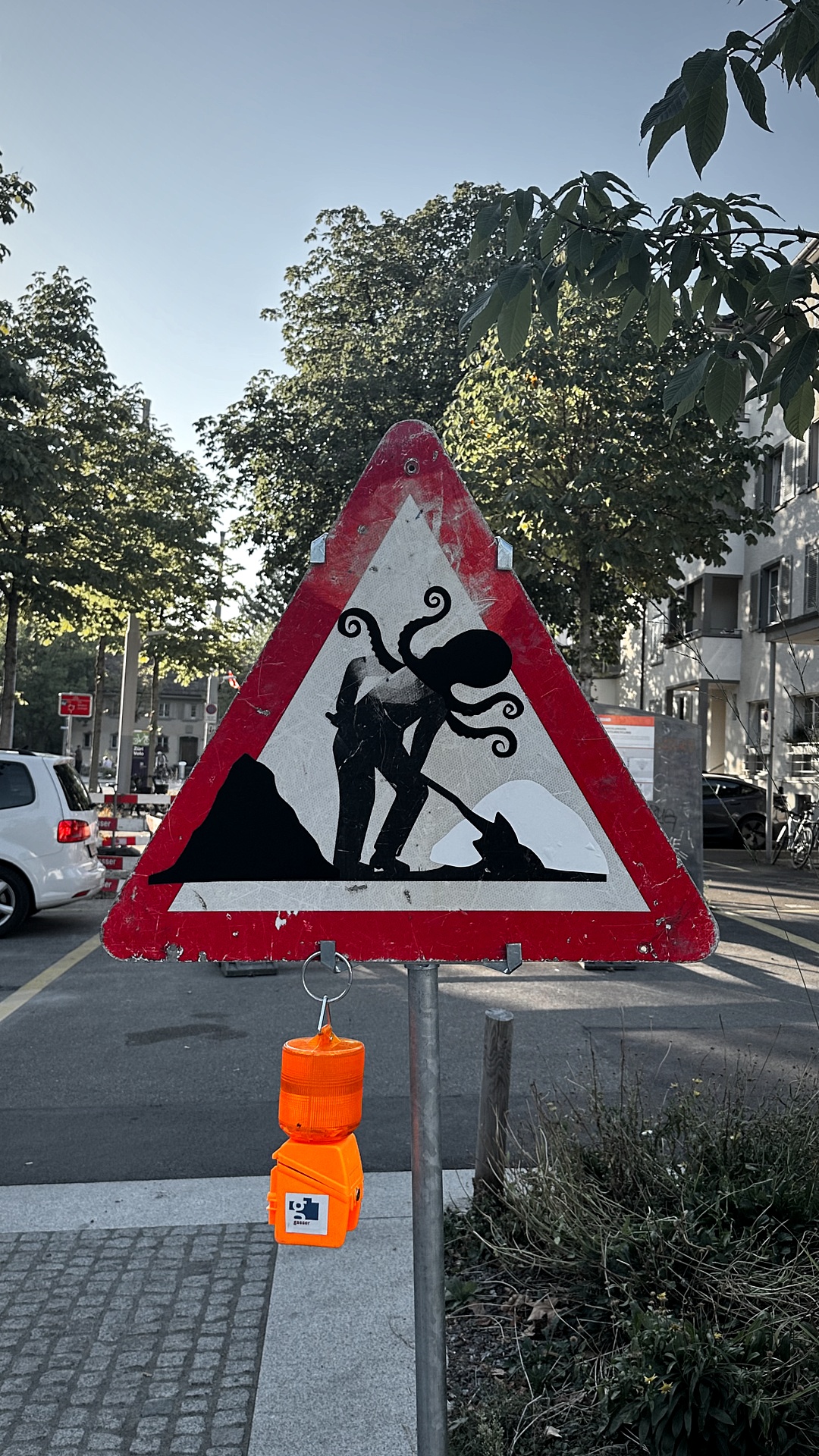
- The octopus — tentacles curling out of the worker's head.
- The squid face — tentacles hanging where the mouth should be. Twice.
- The stag — a full set of antlers.
- The panther — an entire black cat, tail and all, standing where the man was.
- The rabbit — two long ears, and a green dot somebody stuck on the sign.
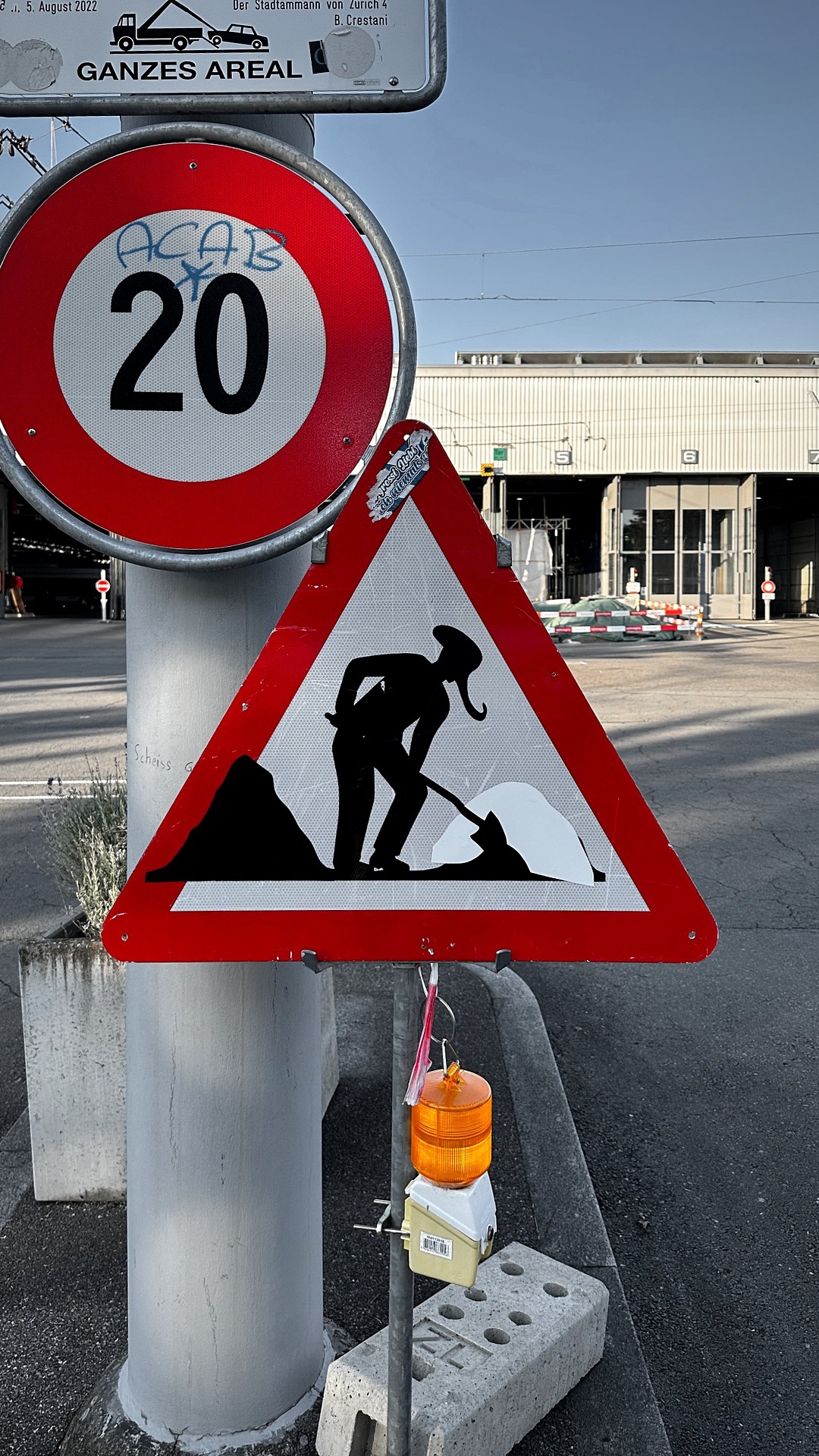
- The elephant — ear and trunk, unmistakable once you see it.
- The bird of prey — a hooked beak and a wing instead of an arm.
- The long-beaked bird — a heron, or an ibis, digging on a shutter covered in graffiti.
- The goat — long muzzle and a tail. Some days I think it's a fox.
- Another long-snouted one — related to the elephant, but not the same animal.
- The one in a flat cap — no animal at all, just a worker who got a hat.
- The one with a single googly eye — and this is my favourite. I photographed this sign eight times. On 14 August the worker has no eye. By 31 August a plastic googly eye is stuck to his head. I have no idea who put it there, and that turns out to be the interesting part.
The remaining five are signs where I found the drawing already buried: under layers of stickers, under a wall of spray paint, or scratched off. I keep them in the catalogue because the count should be honest — not every hunt ends with an animal.
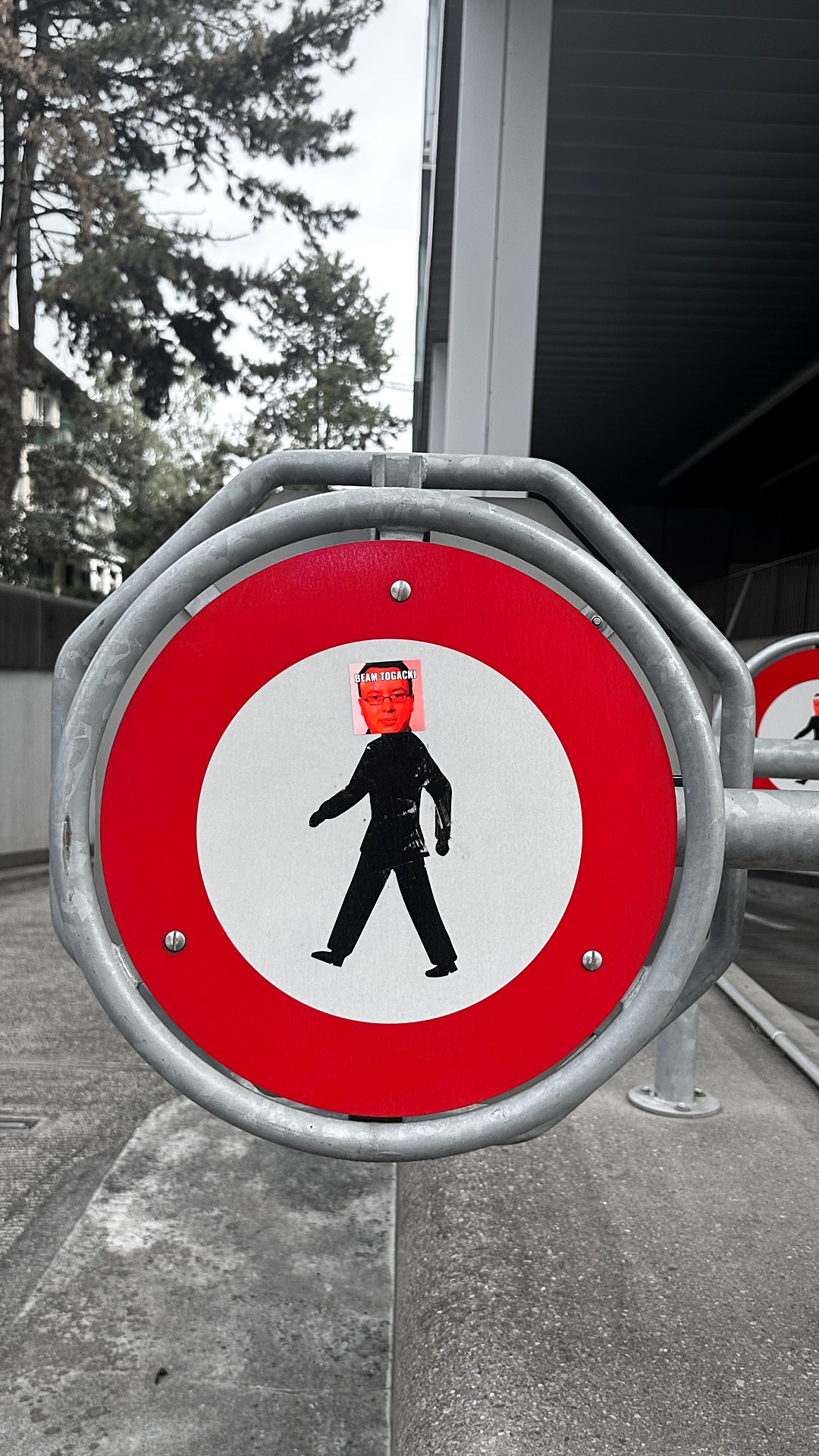
One I had to throw out. A round "no pedestrians" sign where the walking man had a head that wasn't his: close up, it turned out to be a printed sticker of someone's face, not a drawing. Different vandal, different intention.
03. Once one person starts, everybody feels invited
Here is the thing I did not expect to find, and the reason I kept photographing.
A modified sign almost never stays alone. Fifteen of my twenty-three signs carry somebody else's mark as well — a sticker, a marker tag, a spray scribble, right there on the sign face — and five of those are so covered that the drawing underneath is barely readable. The signs where only one hand has been are a minority.
And these are clearly not all the same person. Whoever draws the animals works inside the rules of the pictogram: black on white, inside the red border, in the same visual language the sign was printed in. The rest don't bother. A tag goes straight across the worker's body. A round sticker lands on his chest. A band promotes a gig. Some of the marks aren't even about the sign — the FCZ lettering you find on several of them is the football club's language, sprayed all over this city on every kind of surface; the triangle just happened to be in the way.
What seems to happen is that the first intervention breaks a spell. The sign stops reading as municipal property — untouchable, official, somebody else's — and starts reading as a surface that is already in play. Once there is a drawing inside the triangle, everybody feels a little more entitled to add their bit: to tag it, to sticker it, to retouch it, to finish someone else's joke. Permission spreads.
I want to be careful about what I can actually prove here, because it is tempting to tell a neater story than the photographs support. I photographed three signs twice. Two of them did not change at all between visits — six days on one, nine on the other. The third is the one with the eye: on 14 August it had a tag and a pink spray scribble and no eye; on 31 August the googly eye was there. So something was added to a sign that had already been drawn on and tagged — and I cannot tell you by whom. It could be the person who drew the animals, coming back. It could be somebody else entirely, joining in. A stuck-on plastic eye isn't even the same technique as the drawings, which makes me lean towards a second hand, but leaning is not knowing.
That uncertainty is the observation, not a gap in it. These triangles have become collective. There is no single author to find, no chronology to reconstruct from the outside — only a surface that several people, with very different manners, have each decided belongs a little bit to them. What I can still tell apart is the manners: one of the voices is trying to be funny in the sign's own language, and it is the only one that is.
04. Why it matters to me
Zürich is a city of rules, and the rules mostly work. The trams arrive at the minute printed on the board. The pavements are clean. Everything on the street is there for a reason, and it tells you the reason: where to walk, where to stop, what is forbidden, who is watching. I have a lot of affection for that competence — but there are days when a city that always behaves can feel like a room with no windows open.
These signs open a window. Somebody took the most bureaucratic object on the street, the one that exists purely to say careful, works ahead, and drew a joke inside it. No signature, no brand, no QR code, nothing asked of me in return. The joke is only for whoever happens to look up.
So now I walk differently. I catch myself checking every roadworks sign on my way somewhere, hoping today is a day I find a new one. Twenty-three in five weeks means I am not finding them by luck any more; I'm hunting. That small change in how I move through the city is what this whole thing is about. It is not a lot, and it is not nothing: a crack in the rigidity, opened by someone I don't know.
05. I'm looking for the artist
I would very much like to find whoever draws the animals.
Not to expose anyone — if they want to stay anonymous, that is the right answer and I'll respect it completely. I'd like to say thank you. I'd like to credit them properly here, on the page about their own work. And I'd like to ask whether they mind me photographing it and putting it together like this. I would also love to know how much of what I found is theirs, and how much is other people answering them.
If you know who draws on the roadworks signs in Zürich, please write to me: hi@algazal.co. If you are the artist: the same address, and thank you.
06. Why there is a film, and why it sits here
This is not a project of ours, and none of the typologies in the index fits it. It isn't architecture, it isn't an installation, it isn't a product, it isn't a commission. Filing it as one of our works would be a small lie. So it is filed as what it is: an observation. A thing I noticed in the street and wanted to share.
What is mine is the way of looking. Forty-five photographs, taken at different distances, different angles, different times of day, on different streets. Looked at one by one, they are snapshots. Stacked on top of each other with the sign held perfectly still, they become something else: one single sign, in one single place, that keeps transforming — while Zürich flickers around it like weather.
The illusion is the argument. If the sign never moves and everything else does, you stop looking at the street and start looking at what people have done to it.
07. How the film was made (this part is mine)
The problem. To make one sign out of forty photographs, the sign has to land on exactly the same pixels in every frame. Not roughly — exactly. A shift of two or three pixels between cuts reads as a jump, and the illusion collapses. And no two photographs were taken from the same spot: the sign is bigger here, tilted there, seen from below on the other one.
An editing programme cannot do this. In CapCut or Premiere I would have to set position, scale, rotation and perspective by hand, forty times, matching an accuracy the eye cannot even see. And an editor has no idea what a road sign is — it can only move a rectangle around.
So I wrote a small program instead. Python, with OpenCV for the computer vision, numpy for the arithmetic and the sound, and ffmpeg to write the video. Python because that is where computer vision lives, and because it lets the computer measure the sign instead of me guessing at it. The whole thing runs on my laptop: photographs in one folder, one command, film out the other end.
The model. The program carries an idea of the sign: an equilateral triangle, apex up, side length 1, and a red border whose inner edge is 0.731 of the outer triangle. That number is not invented — the program measured the border on every photograph and took the median, so the ideal sign is an average of the real ones.
The axes. That ideal triangle becomes the coordinate system of the entire film. Every photograph is asked one question: which transformation puts your sign exactly onto the ideal one? The answer is a matrix, and applying it rotates, scales, de-skews and re-centres the whole photograph at once. The sign becomes the origin; the city is what happens to be attached to it.
Finding the sign. First a coarse pass looks for how "sign red" each pixel is and hunts for triangular red shapes — and, just as importantly, for the triangular white face enclosed by red, which still works when the red-and-white barrier posts behind the sign touch its border. Then the precise pass: the program measures the six straight edges of the border, three outer and three inner, searching across each edge for the exact red-to-white transition, to a fraction of a pixel. Lines are fitted with a method that throws away whatever disagrees — which is how the stickers, the tags, the posts and a bent corner get ignored instead of dragging the fit off. Given that two thirds of the signs have been written on by several hands, this turned out to be the single most important part of the program.
Perspective, only where it's real. When a photograph was taken from below or from the side, the sign is a trapezoid and needs a full perspective correction. When it was taken head-on, inventing perspective would warp the city for no reason. So the program fits both and keeps the perspective only when the six edges genuinely support it.
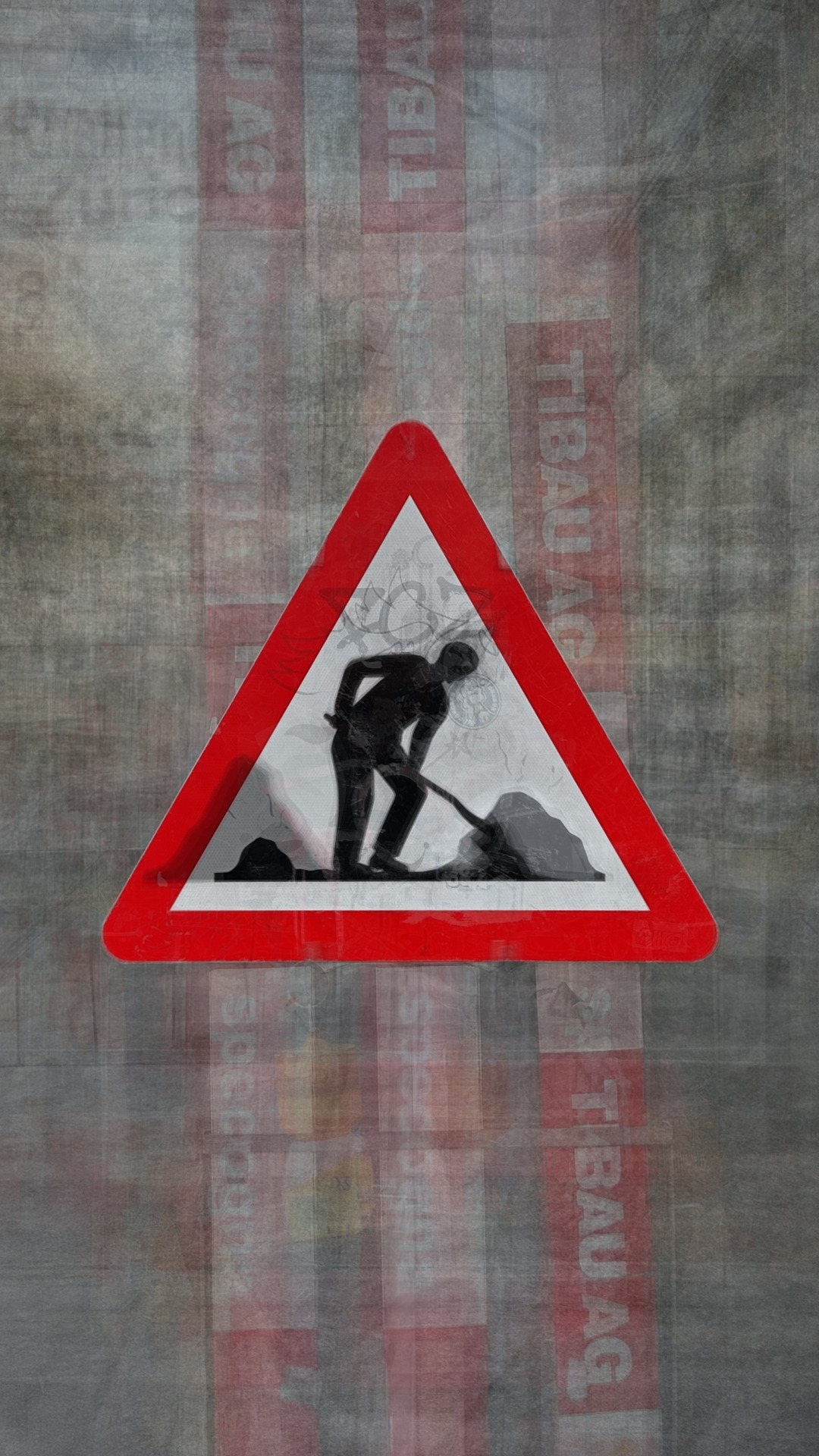
Checking, instead of trusting. After the frames are finished, the program goes back and re-measures the sign inside its own output. Across the whole film the sign sits a median of 0.07 pixels from its target, worst case 0.54. There is also a proof you can see, and it is the cover of this page: average all forty frames into one image and the sign comes out sharp while the city dissolves into a ghost. If the alignment were off, the sign would blur first.
The frame. The sign's size and height in the frame are not a taste decision either. The program tries every size and picks the one where the sign is as small as possible — the most city you can see — while nearly every photograph still fills the 9:16 frame edge to edge. It landed at 80% of the frame width, centred at 53% of the height. Photographs whose sign was too small to enlarge without going soft are left out rather than smuggled in, which is why five of the forty-five didn't make the film.
The cut. 1080 × 1920, 24 frames per second, 14.5 seconds, hard cuts only — no dissolves. The perfectly locked sign is itself the transition, and a dissolve would only soften the punch. Every shot length sits on a 120 bpm grid (one beat is exactly 12 frames), so the film is rhythmically countable: one second on the opening sign, then half a second per photograph, then a third, a quarter, a sixth as it accelerates, a pause of a second and a half on one sign, back to a quarter, and two seconds on the last frame. The order isn't chronological: each cut jumps to the photograph that differs most from the one before, in both the street and the drawing, so nothing similar ever sits side by side.
The colour. The city is desaturated and the sign's red is pushed the other way, so the red belongs to the sign and everything else recedes. Measured on the finished frames, the city sits at a saturation of 26 and the sign's red at 226.
The music. Written in code too, sample by sample, so there is no copyright in it and nothing borrowed. The percussion is a building site: a hammer on a steel plate, a jackhammer, gravel, the tick of a trowel — synthesised, not recorded. Under it, a techno spine: a deep kick on every beat and a bass stab on every off-beat. The arrangement isn't composed by hand — the program reads the edit and follows it. The faster the cuts, the denser the hammers. When the film pauses on one sign, the drums drop 14 decibels and a single hammer is left ringing in the space. On the last frame there is one final hit, and its tail decays under the image. Because it is generated from the edit, it is always exactly as long as the film, and it always lands on the cuts.
One honest note. There is no footage in this film. Nothing moves, nothing was filmed. Every frame is a still photograph taken standing on a pavement in Zürich.
08. Where, when, with whom
Zürich, Switzerland. 23 signs catalogued between 14 August and 22 September 2026, and still counting — I photograph them as I find them.
The drawings are the work of an artist I have not yet found, and some of what is on those signs is the work of people I will never identify. The photographs, the film, the alignment tool and the music are mine. If you know who draws them, or if you are them: hi@algazal.co.